Top Signs You Need Garage Door Service – Don’t Ignore These
Most homeowners wait for a garage door to fail before they call anybody. That’s backwards. By the time a torsion spring sounds loud or grinds, it has already lost a chunk of its structural integrity, and the real warning was sitting in the cable drum groove months earlier, silent and easy to miss. The signs that actually matter are physical and quiet. This is what to look for in Inwood before a small wear item turns into a door that won’t budge.
The Signs You Notice Are Usually Late-Stage Symptoms
A slow door, a groan on the way up, one loud bang from the ceiling of the garage: those are the symptoms people describe when they call. They aren’t early warnings. They’re what a worn component sounds like once it has already given up most of its margin. A torsion spring that snaps on a Tuesday morning has been weakening for weeks, losing tension coil by coil, and the door simply worked fine until it didn’t. The same goes for a cable that finally lets go. It was fraying strand by strand long before anything felt wrong from the driver’s seat.
That gap between early wear and a noticeable symptom is where a garage door becomes a genuine hazard, not just an annoyance. Springs, cables, and the brackets that hold them under tension store real force. When one of them gives way, it gives way fast, and the safest move is to catch the wear before that point. In our experience, the doors that turn into emergencies in Inwood are almost never the ones somebody was inspecting. They’re the ones nobody looked at until they stopped working.
Here’s the reframe this whole piece is built on: instead of watching for the loud failure, look for the quiet, mechanical tells. They live in five specific spots, and they take about 90 seconds to check.
Five Inspection Points That Reveal Wear Before It Fails
Any garage door built by Genie, Clopay, Amarr, Wayne Dalton, or anyone else carries the same basic wear points. You don’t need a manual. You need to know where to put your eyes and what “wrong” looks like. A quick monthly walk-around covers all five:
- Cable fraying. Look at the cables running along each side of the door, especially near the bottom corners and the drum at the top. A healthy cable is smooth and uniformly wound. Broken strands poking out, a fuzzy texture, or a kink that won’t straighten means it’s on its way out.
- Spring coil gap. On a torsion spring above the door, the coils should sit tight and even. A visible gap between coils, a spring that looks stretched compared to how it started, or rust creeping into the gaps all point to tension loss.
- Roller flat-spots. Rollers should roll, not skid. If you can see a flat worn into a roller’s edge, or the door shudders as it moves, that roller is dragging instead of rolling.
- Bottom seal compression. The rubber seal at the bottom should press evenly against the floor. Daylight showing under one side, a seal that’s crushed thin in one spot, or a seal that’s torn and hanging tells you the door is out of level or the seal has aged out.
- Track scoring. Run your eyes down both vertical tracks. Deep scratch marks, a shiny worn stripe, or a ding where a roller has been fighting the track all mean misalignment that will wear out the whole system faster.
None of these require touching a spring or a cable under tension, and none of them are safe to fix by hand once you spot a problem. If something looks off, that’s your cue to get it looked at, not to grab a wrench. When it’s time for that, our garage door repair covers the full range of these failures.
Uneven Movement Means Something Is About to Let Go
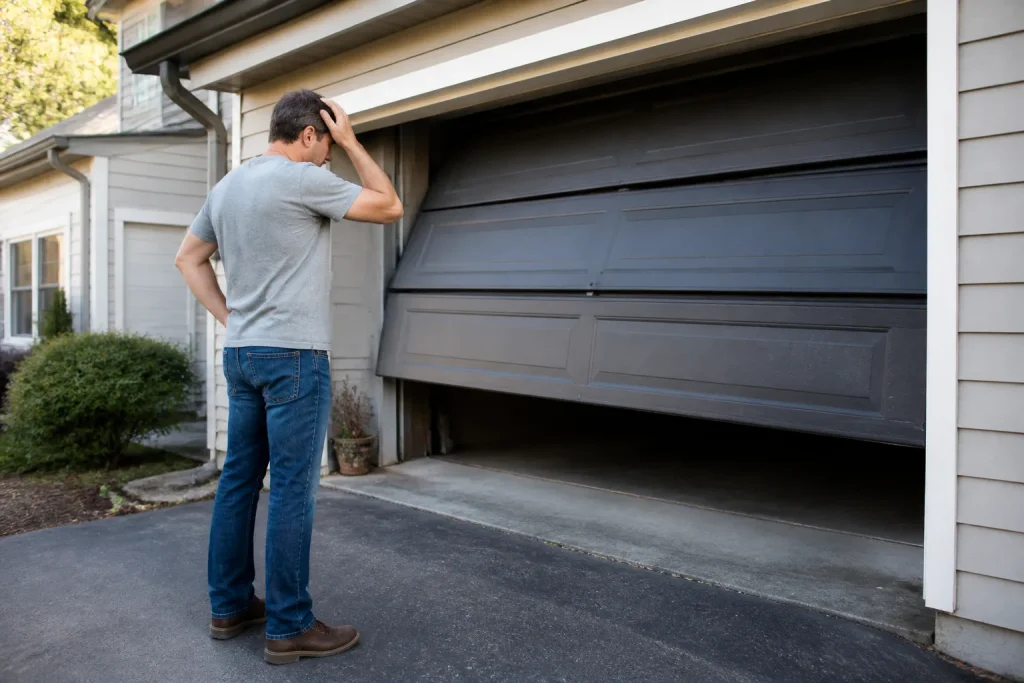
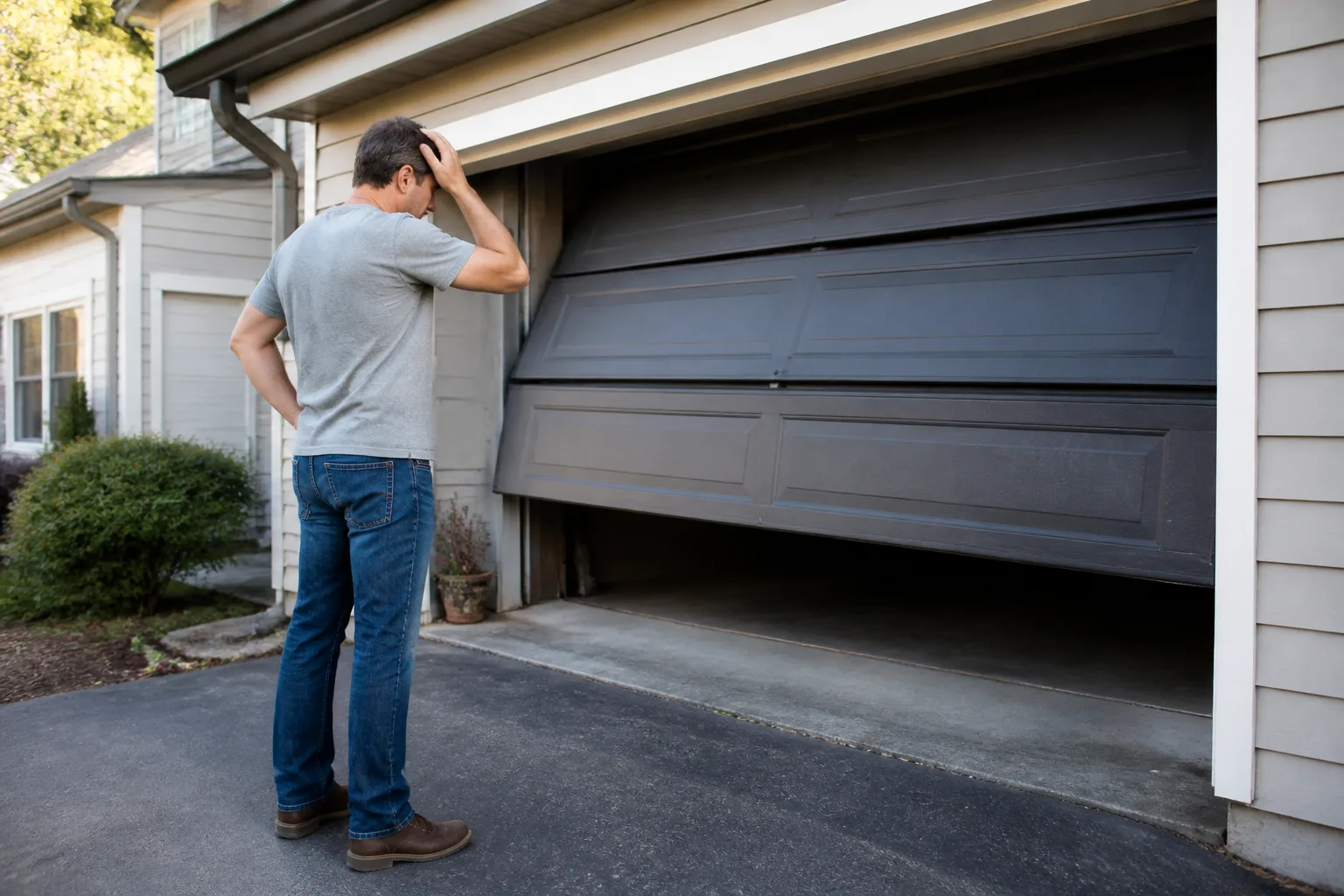
Watch your door travel from open to closed. Both sides should rise and fall together, staying level the whole way. If one side runs about two inches ahead of the other, that’s not a door that needs a small adjustment. That’s a door telling you one cable is slackening or one side is losing lift, and an uneven door puts the entire weight of the panel on the stronger side. That’s how a cable snaps.
The same test applies on the way down. A door that lands crooked, or where one corner touches the floor first, is being pulled unevenly. In Inwood, we see this most on doors that have been doing daily duty for a while without anyone checking the balance. The hardware on one side wears at a different rate than the other, and the door slowly starts to list. Left alone, that uneven pull is the single most direct path to a snapped cable or a bent section.
Don’t try to level a door by adjusting cables or springs yourself. Those components are under load even when the door looks closed and quiet. This is the kind of work where the risk lands on whoever reaches in first. If your door tracks crooked, that’s a call-a-pro moment, not a weekend project.
Test Your Door’s Balance in 30 Seconds
Balance is the clearest read you’ll get on spring health, and you can check it without tools. Here’s how it works: open the door partway by hand, then let go. A properly balanced door should sit exactly where you leave it, suspended and steady. If it drops, the springs are losing tension and can’t hold the door’s weight. If it rises on its own, the springs are over-tensioned, which strains the opener and the door.
What that resting position tells you is simple. A door that sags has springs that are already weak, and weak springs push the work onto the opener, which isn’t built to lift the door by itself. That mismatch burns out openers and, over time, leaves the door heavy enough that a worn spring finally gives. A door that won’t hold still is a door with a spring problem brewing.
Run this test when the door is cool and nobody’s standing under it. If it won’t hold, note it and call. Springs are the most dangerous component in your garage door system, and this is exactly the check that flags a bad one before it breaks. If your opener is also straining or dragging, our garage door opener repair handles the LiftMaster and Chamberlain systems most Inwood homes run, plus the legacy units that still work fine.
Listen to the Sound: Snap, Scrape, or Thud
Your ears catch things your eyes miss. A door near failure almost always makes one of three sounds, and each points at a different problem. Learning to tell them apart is one of the most useful habits you can build, because the sound is often the last thing you get before a breakdown.
- A snap. A sharp, sudden crack from above the door usually means a spring or cable has let go. If you hear it, stop using the door immediately. Don’t touch anything and don’t try to open or close it. Call for emergency service.
- A scrape. A metallic grinding or scraping sound as the door moves points to a track or roller problem. A worn roller skidding in its track, or a bent track rubbing a hinge, makes that noise. It’s slower to fail than a snap, but it wears everything it touches.
- A thud. A heavy, dull thump, especially at the top or bottom of travel, is often the door slamming into a limit or an opener that’s lost its adjustment. A Genie or Chamberlain unit that thuds at the end of the cycle is usually a signal to check the opener’s travel settings before it damages the door.
If you hear a snap, that’s a same-day call, and our emergency garage door service is built for exactly that kind of failure. For scrapes and thuds, don’t wait for them to become snaps either. The Garage Door Repair Inwood team can look at the track, rollers, and opener together and tell you what’s actually worn.
Why a Door That Works in July Fails in January
A door that runs smoothly all summer and then starts acting up in the cold isn’t being temperamental. Metal contracts in the cold, and that contraction changes the tension in everything holding your door’s weight: springs tighten, cables lose or gain stretch, and the whole assembly moves toward the edge of its tolerance. An Inwood winter pushes a door that was already near the end of its spring life over that edge.
So a stubborn door on a cold morning isn’t the first sign of trouble. It’s the same slow wear that piled up all year, laid bare by the season. That’s why the monthly check matters more as temperatures swing. Fresh cable fraying, a newly visible spring gap, or a door that suddenly won’t hold its balance in the cold are all signals that whatever was borderline in warm weather has tightened into a real problem. The fix is the same one you’d have needed weeks earlier, just less convenient now.
Catching it early is also the cheapest route. A tired roller or a worn bottom seal is a small job compared to a snapped spring that takes the opener down with it. If your door is struggling in the cold, the garage door installation team can also tell you whether repair is worth it or whether the door and its hardware are simply through.
When to Call a Pro
Some of the signs above you can watch. Some you should never touch. Anything involving a spring, a cable, or the brackets that hold the tension is off-limits for DIY, because those parts are under load and give no warning before they release. The same goes for anything that sends the door up or down unevenly, any snap or bang, and any door that won’t stay balanced when you let go. Those are stop-and-call situations, not adjust-it-yourself ones.
Watch-and-wait territory is smaller than most folks think: a scraping track, worn rollers, a flattened seal, a thud at the opener’s limit. Even those are worth a quick look from someone who works on doors daily, because they’re the earliest, cheapest catches. Our technicians have up to 12 years of experience across brands like LiftMaster, Chamberlain, Genie, Clopay, Amarr, Wayne Dalton, Craftsman, and Raynor, so we work on the door and opener you already have.
Related services in Inwood: garage door repair, opener repair, spring repair, and new door installation, all handled by the same team from the first service call through the life of the door. From the opener to the panel to the spring, one call covers it.
The Bottom Line
The signs that matter most are the quiet ones: frayed cables, a spring coil gap, flat-spotted rollers, a crushed bottom seal, scored tracks, and a door that won’t hold its balance. Add the uneven travel and the snap-scrape-thud sound test, and you’ve got a 90-second routine that catches wear before it becomes an emergency. The spring that goes bang in January was sending notices all fall. Learn to read them.
If you’re in Inwood and need help, Garage Door Repair Inwood offers free estimates and upfront pricing, and the price is quoted and agreed before any work starts. Call (877) 584-3370 and we’ll get your door back up and running. We connect you with a local pro who is licensed and insured as their state requires.
Frequently Asked Questions
The earliest reliable sign is usually a balance failure: open the door partway by hand and it won’t stay put, dropping or rising on its own. That points to spring tension loss, often weeks before you’d hear anything unusual. Check it monthly and you’ll catch most wear early. Call (877) 584-3370 for a free estimate if your door won’t hold its balance.
No. Cables and springs are under heavy tension and can release without warning, so this is work for a trained technician. A frayed cable or a spring gap is a stop-and-call situation. Springs are the most dangerous component in your garage door system, and we handle them so you don’t have to. Call (877) 584-3370 to book a look.
Cold metal contracts, which changes spring tension and cable stretch, so an Inwood winter exposes wear that warm weather was hiding. A door that works all summer and drags in January needs service, not patience. The underlying problem was building for months. Call (877) 584-3370 for a free estimate and we’ll tell you what’s worn.
No, not without your say-so. We quote and agree on a price before any work starts, and the written estimate sets the final price, so there are no surprise invoices. If we find something extra once we’re in, we’ll show you and you’ll agree before we touch it. Call (877) 584-3370 for a free estimate.
Written by the team at Garage Door Repair Inwood.
Need Garage Door Help?
Call Garage Door Repair Inwood - the local pro we connect you with is licensed and insured, here with fast after-hours help in Inwood.
(877) 584-3370