Garage Door Repair: Repair or Replace? How Inwood Homeowners Decide
Most homeowners assume the door’s age settles the question. It rarely does. A 15-year-old door with a snapped cable is often worth repairing, while a 7-year-old door with a cracked panel sitting on a corroded track system usually isn’t. The variable that actually matters is the type of failure, not the birthday of the door. If you’d rather have someone look at it than guess, call (877) 584-3370.
How do you decide between repairing and replacing a garage door?
You compare three things: the cost of the repair, how much mechanical life the door has left, and whether the failure is a one-time event or a sign of system-wide decline. Age sits at the bottom of that list because a well-maintained door and a neglected one of the same vintage behave completely differently. A door that has been lubricated, balanced and adjusted over the years can easily outlast a newer one that has been ignored.
The short version for Inwood homeowners:
- Isolated failure on a sound door: repair. Cables, rollers and springs wear out on a schedule.
- Repeated failures in the same system: investigate the underlying cause before paying for the same fix twice.
- Structural panel or track damage: replacement usually wins on cost and safety.
- Mechanically sound but leaking, dented or outdated: replacement becomes a value decision, not a repair decision.
The mistake we see most often is treating every failure as a fresh, unrelated problem. A garage door is a mechanical system, and one failed component often stresses its neighbors. That’s why the failure type tells you more than any age threshold you’ve read online.
Which garage door failures are isolated incidents, and which signal decline?
Some failures are genuinely one-off events that say nothing about the rest of the door. A snapped lift cable on a door that otherwise runs evenly, a worn roller, a single broken hinge: these are parts doing their job for years and then reaching the end of their service life. Repair them and move on. The rest of the system is fine.
Other failures are symptoms. Here’s how we sort them:
- Isolated: a single cable, one roller, a worn bottom seal, a failing opener remote or wall button.
- Systemic: a broken torsion spring on a door with visibly uneven panels, a bent or rusted track section, repeated off-balance symptoms, sagging sections, or a door that has never run smoothly.
In Inwood, the housing stock varies widely, and that matters. Some garages here are attached structures that have been modified and extended over the years, while others are detached and exposed to more seasonal temperature swings. A door in a structure with poor drainage and humidity issues will show corrosion-related failures earlier than a door in a dry, well-ventilated garage. When track and hardware are showing rust across multiple components, that’s a systemic signal, and patching one part won’t change the trend.
How do you calculate the repair-to-value ratio using local replacement costs?
National replacement averages won’t help you here. Garage door installation in Inwood is priced by local labor, door size, material and brand, and the numbers vary enough that the generic online figure is often misleading in either direction. The right calculation uses a written estimate for the specific replacement, not a national average.
The practical method:
- Get a written repair estimate for the failure in front of you.
- Get a written replacement estimate for a comparable door, in the same material, from the same measure.
- Divide the repair cost by the replacement cost. If the repair runs a third or more of a full replacement on a door with visible wear across other components, replacement is usually the better call.
- Factor in remaining life. A repair that buys a few years on a door near the end of its mechanical life is a stopgap, not a solution.
We work with Clopay and Amarr doors frequently, and both make entry-level and mid-range models that come in close enough on price that the decision usually comes down to the existing door’s condition rather than the replacement itself. Along with Chamberlain, Genie and the rest of the eight major brands we’re trained on, that means we can quote a repair and an honest replacement comparison on the door you already own. The written estimate sets the final price either way, so ask for both before you commit.
For the installation side of that comparison, see garage door installation.
When does panel damage mean replacement instead of repair?
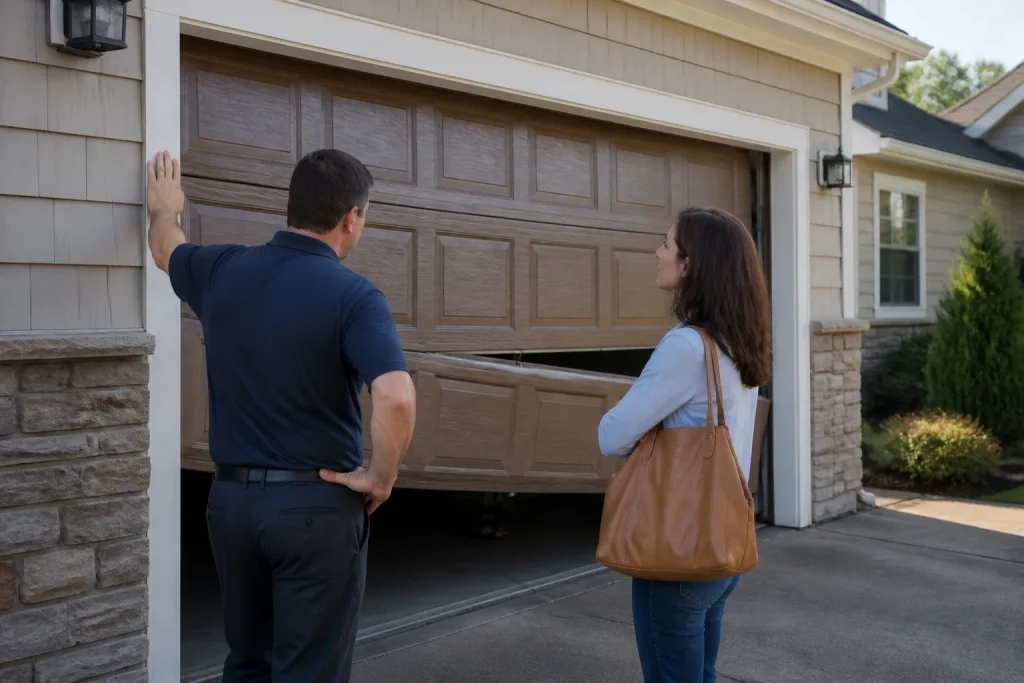
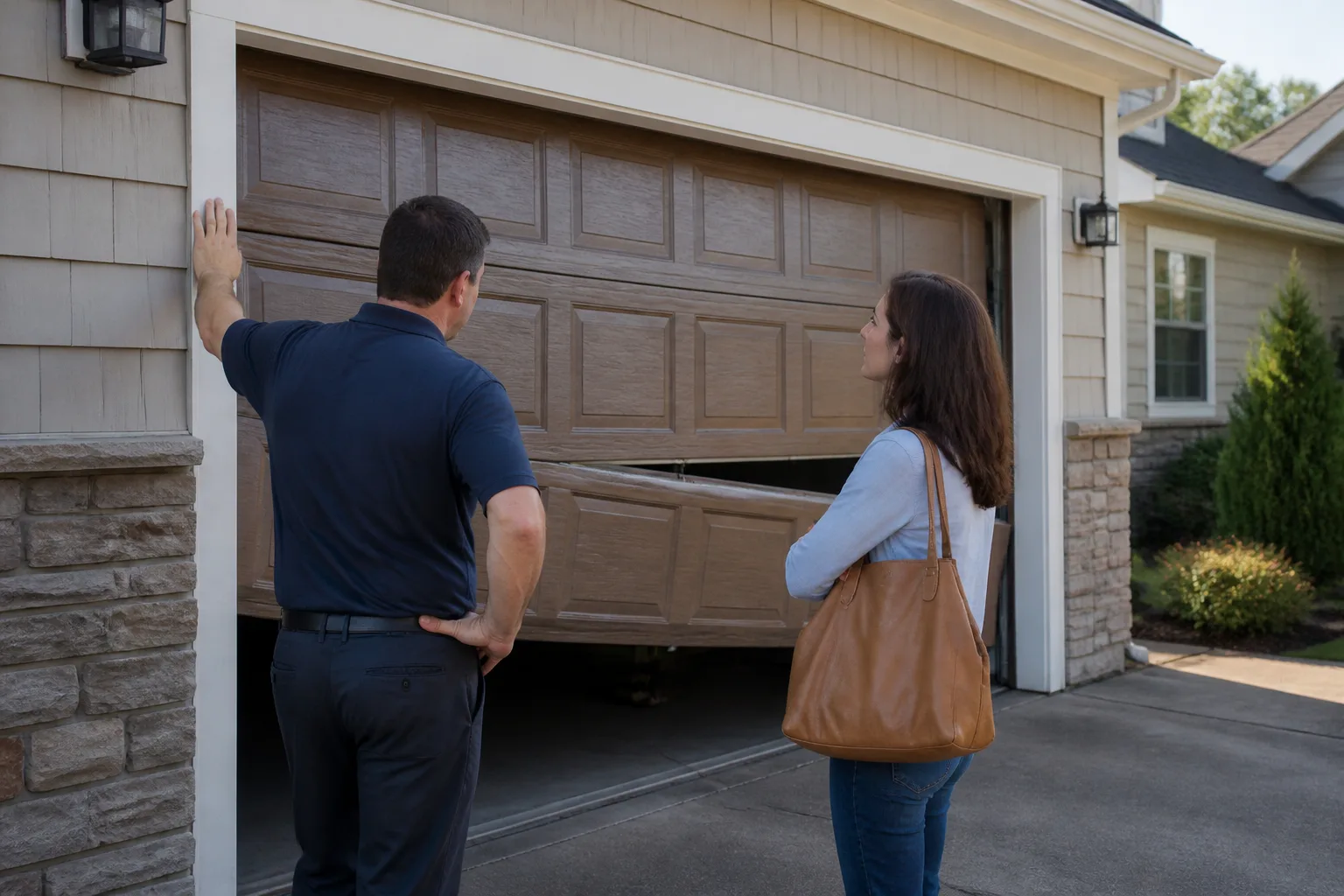
It depends on whether the failure is cosmetic or structural. A dented or scratched panel on a door whose structural frame is sound and whose bottom section is intact is a cosmetic problem. It’s annoying to look at, but the door still does its job. A cracked, split or buckled panel, or damage to the bottom section, is a structural problem, and that’s a different conversation.
Here’s the distinction:
- Cosmetic panel damage: surface dents, scrapes, or faded finish. Repair or refinish if the frame, tracks and hinge points are sound.
- Structural panel damage: cracks, splits, buckling, or damage to the bottom section. Even a single affected panel can compromise the door’s balance and its sealing, and that usually tilts the decision toward replacement.
Panel replacement is possible on many doors, but it only makes sense when the rest of the door is healthy. If the panel failed because the bottom section was taking on water or the track has bent, replacing one panel just gives the failure somewhere else to happen. In Inwood, where we get real seasonal freeze-and-thaw cycles, a bottom section that stays wet or holds ice is a common cause of premature panel failure. That’s a structural issue, not a cosmetic one, and it’s worth dealing with the cause rather than the symptom.
Which repairs tend to be followed by a second failure?
Three repair types have a habit of being followed by a more expensive failure within roughly 18 months if the underlying cause is ignored. We’d rather tell you upfront than have you pay twice.
- A single broken torsion spring on a paired system. When one spring of a matched pair breaks, the other has lived the same cycles. Replacing only the broken spring is a common cheap fix, and it often leads to a second spring failure and a door that’s out of balance in the meantime. Replacing the pair together is the reliable route.
- Cable repair on a door with a bent or misaligned track. A cable doesn’t fail in isolation if the track is pulling the door off its line. Fix the cable and leave the track, and the new cable takes the same stress.
- Opener repair on a door that’s mechanically stiff. A strained opener often fails because the door is hard to move, not because the opener is bad. Replace or repair the opener alone and the new unit inherits the same mechanical drag. This is one reason we treat garage door opener repair as a system check, not a box swap.
The pattern is consistent: the second failure happens because the first fix addressed the part and not the cause. Ask whether the estimate explains why the failure occurred. If it doesn’t, get a second opinion.
When does a new door make sense on a mechanically sound door?
Sometimes the door works fine and replacement is still the right call. That’s a value decision, not a mechanical emergency, and it usually comes down to three things: sealing, energy performance, and how the door affects the property.
Aging doors often have tired seals and gaps that let air and moisture through. In Inwood’s climate, where summers run humid and winters bring freeze-and-thaw, a door that can’t seal properly costs you comfort and lets moisture reach the bottom section. A newer door with a proper seal solves that in one step. Homeowners also weigh curb value, especially if they’re planning to sell or refinance and want the garage to stop being the weakest face of the house. Our advice: if the door is mechanically sound, get a free measure and a written installation price so you can compare that number against the sealing and appearance improvements. That way it’s a number, not a feeling.
When should you call a pro?
Call a professional for anything involving the springs, cables or torsion system. Those components hold the door’s full weight under tension, and a failure can cause serious injury. We handle them so you don’t have to, and we don’t recommend attempting them yourself. Also call if the door is off its track, if the opener is straining, or if you’re seeing repeated failures in the same system. We respond to emergency failures and can usually get a door back up and running today.
Related services in Inwood: Garage Door Repair Inwood covers the full range, and for the general repair side see garage door repair.
The Bottom Line
Age is the least useful variable in the repair-or-replace question. Judge by failure type first: isolated failures on a sound door are repairs; systemic failures across springs, tracks and hardware point toward replacement. Then run the repair-to-value ratio against a local written replacement estimate, not a national average. And treat structural panel damage, especially to the bottom section, as a replacement conversation rather than a cosmetic one.
If you’re in Inwood and need help deciding, Garage Door Repair Inwood offers free estimates with a written, agreed price before any work starts. Call (877) 584-3370. Our technicians have up to 12 years of experience and work on the eight major brands, so the door you already own is covered.
Frequently Asked Questions
If the same system keeps failing, find the cause before spending on another repair. Repeated failures usually mean a track, balance or hardware problem that one fix won’t solve, and in that case replacement is often cheaper over time. Call (877) 584-3370 for an honest assessment and a free estimate.
Usually not on a matched pair, because the second spring has the same cycles on it and often fails soon after. Replacing the pair together is the reliable choice. Call (877) 584-3370 and we’ll quote both options in writing.
Yes, if the damage is cosmetic and the frame and bottom section are intact. If the panel is cracked, buckled or the bottom section is affected, replacement of the door is usually the better call. Call (877) 584-3370 to have it evaluated.
No. We quote and agree the price with you before any work starts, and the written estimate is what you pay. Call (877) 584-3370 for a free estimate.
Written by the team at Garage Door Repair Inwood.
Need Garage Door Help?
Call Garage Door Repair Inwood - the local pro we connect you with is licensed and insured, here with fast after-hours help in Inwood.
(877) 584-3370